### The Ludic Fallacy: An In-depth Exploration of Pitfalls in Modeling the Real World
#### Introduction
[](https://upload.wikimedia.org/wikipedia/commons/9/9b/Taleb_mug.JPG)
*Nassim Nicholas Taleb, author of 'Fooled by Randomness'*
In Nassim Nicholas Taleb's first volume of his *Incerto* series, *Fooled by Randomness (FBR)*, he introduces the concept of the 'ludic fallacy.' This fallacy refers to the confusion between the uncertain, complex real world and our innate need to simplify it by applying models derived from games of chance and statistics. Such misplaced confidence in our models and tools may lead to suboptimal decision-making and severe consequences when these models encounter the inherent unpredictability of the real world.
In essence, the ludic fallacy arises due to the:
[](https://www.proprofsproject.com/blog/wp-content/uploads/2023/09/What-Is-Decision-Making-in-Project-Management-4-1024x918.webp)
*Decision-making pitfalls diagram*
1. **Availability bias**, our brain's reliance on recent observations or experiences at the expense of a larger, more informative data set.
2. **Narrative fallacy**, a human tendency to turn facts into stories to make sense of the world and assign meaning to randomness or unrelated events.
3. **Gambler's fallacy**, the mistaken belief that, if something happens more frequently than normal during a certain period, it will happen less frequently in the future.
#### Practical Implications
Let's explore several examples to further elucidate the concept of the ludic fallacy and accentuate its relevance to various fields.
##### Example 1: Risk Assessment in Finance
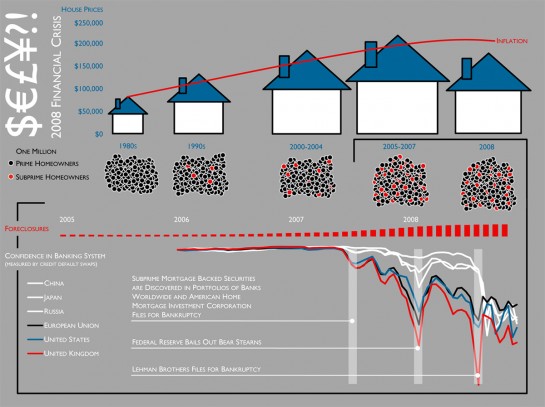
Financial professionals often use statistical models and algorithms extrapolated from usually short-term historical data, leading to dangerously misleading predictions about market trends. This common pitfall was evident during the 2008 financial crisis when banks aggressively lent based on mortgage-backed securities (MBS). They overlooked the inherent risk in part because the lending was lucrative due to artificially low-interest rates. Consequently, banks ignored the minuscule chance of the possibility of a catastrophic housing market collapse and its effect on the overall economy, resulting in one of the worst financial crises in modern history.
[](https://flowingdata.com/wp-content/uploads/2009/03/aler-recession-fullsize-545x407.jpg)
*2008 financial crisis*
##### Example 2: Weather Forecasting
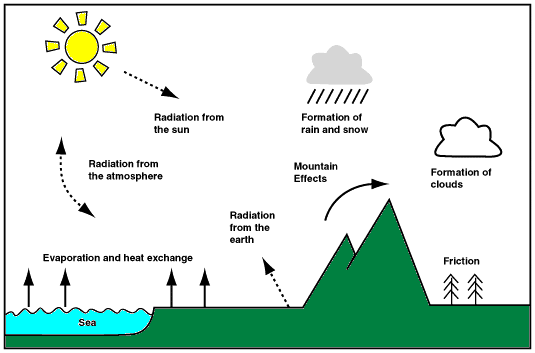
Weather forecasting models rely on quantitative data, mathematical calculations, and computer simulations to predict weather conditions. However, the chaotic and highly complex nature of the atmosphere entails high levels of uncertainty, especially several days in advance. Due to the ludic fallacy, many people tend to trust weather forecasts blindly, resulting in poor decision-making, such as inadequate disaster preparation or unjustified complacency.
[](http://www.atmo.arizona.edu/students/courselinks/spring17/atmo336s2/lectures/sec6/es11fig5.gif)
*Weather forecasting model*
##### Example 3: Game Theory and Strategic Decision-Making
Game theory provides a mathematical modeling framework for analyzing strategic interactions among rational decision-makers. It is anchored on several rationality assumptions and the equilibrium concept, which, when applied in ill-defined or real-world settings, can generate questionable, even bizarre outcomes and policy recommendations, such as the Prisoner's Dilemma paradox, the War of Attrition, or the Tragedy of the Commons. Moreover, based on the ludic fallacy, human agents are often mistakenly treated as uniform, interchangeable, or hyper-rational entities, thus undermining the applicability and legitimacy of the conclusions drawn from the models.
[](https://blogs.cornell.edu/info2040/files/2016/09/Prisoners-Dilemma-roc7os.png)
*Game theory scenarios*
#### Conclusion
The ludic fallacy underscores the chasm between the **simplistic models** we create and the **chaos, uncertainty, and complexity** of the real world. In this interconnected, rapidly-changing modern society, embracing the inherent unpredictability of the real-world becomes increasingly important in our personal and professional lives.
[](https://hbr.org/resources/images/article_assets/2014/01/W_JANFEB_2014_BENNETT_VUCA_610.png)
*Complexity and chaos in real-world modeling*
A few ways for college students to further delve into this topic include:
1. Revisit and reread *Fooled by Randomness* and/or Taleb's subsequent writings, such as *The Black Swan* and *Antifragile,* to better understand the ludic fallacy and the related heuristics and biases.
2. Explore and research additional examples of the ludic fallacy in different fields and industries, such as climate modeling, public health, artificial intelligence, and cybersecurity.
3. Examine alternative approaches and paradigms that account for the inherent unpredictability and complexity in the world, such as complexity science, chaos theory, evolutionary game theory, and agent-based modeling.
4. Explore alternative decision-making strategies and tools, such as Taleb's Antifragility, that can better account for the inherently unpredictable nature of the real world and help us make better decisions amidst uncertainty.
By contemplating these ideas and investigating the ludic fallacy's real-world implications, students can significantly enhance their understanding of and resilience against the pitfalls of the ludic fallacy and other decision-making biases and heuristics.
Last updated: 2024-06-25
Related Books

Related Knowledges