# Black Swan Events: An In-depth Exploration of Nassim Nicholas Taleb's Concept
In his insightful book 'Fooled by Randomness', Nassim Nicholas Taleb presents a number of compelling ideas related to uncertainty, probability, and how we perceive the world. Among these, the concept of a 'Black Swan Event' stands out as a particularly relevant and thought-provoking idea. A Black Swan Event refers to an extremely rare and unpredictable event that has a massive impact. While such events are inherently difficult to predict or even comprehend, understanding the nature of Black Swan Events can provide us with valuable insights and help us make better decisions.
[](https://m.media-amazon.com/images/I/51urVNmy8EL._AC_UF1000,1000_QL80_.jpg)
*Cover of 'Fooled by Randomness' by Nassim Nicholas Taleb*
## Core Concepts and Relevance
Taleb's concept of a Black Swan Event is rooted in the idea that our understanding of the world is often limited by our past experiences and biases. We tend to assume that the future will resemble the past, and that we can use historical data to predict future outcomes. However, Black Swan Events challenge this assumption by being extremely rare, highly impactful, and largely unpredictable.
There are three core characteristics of a Black Swan Event:
1. Rarity: Black Swan Events are extremely rare and do not occur frequently.
2. Impact: These events have a massive impact, often leading to significant consequences.
3. Unpredictability: Black Swan Events are inherently unpredictable and cannot be foreseen using traditional forecasting methods.
The relevance of Black Swan Events extends beyond financial markets and deep into various aspects of life. For instance, the Covid-19 pandemic is a prime example of a Black Swan Event. Despite the abundance of data and sophisticated forecasting models, the pandemic still caught the world off-guard and led to widespread consequences.
[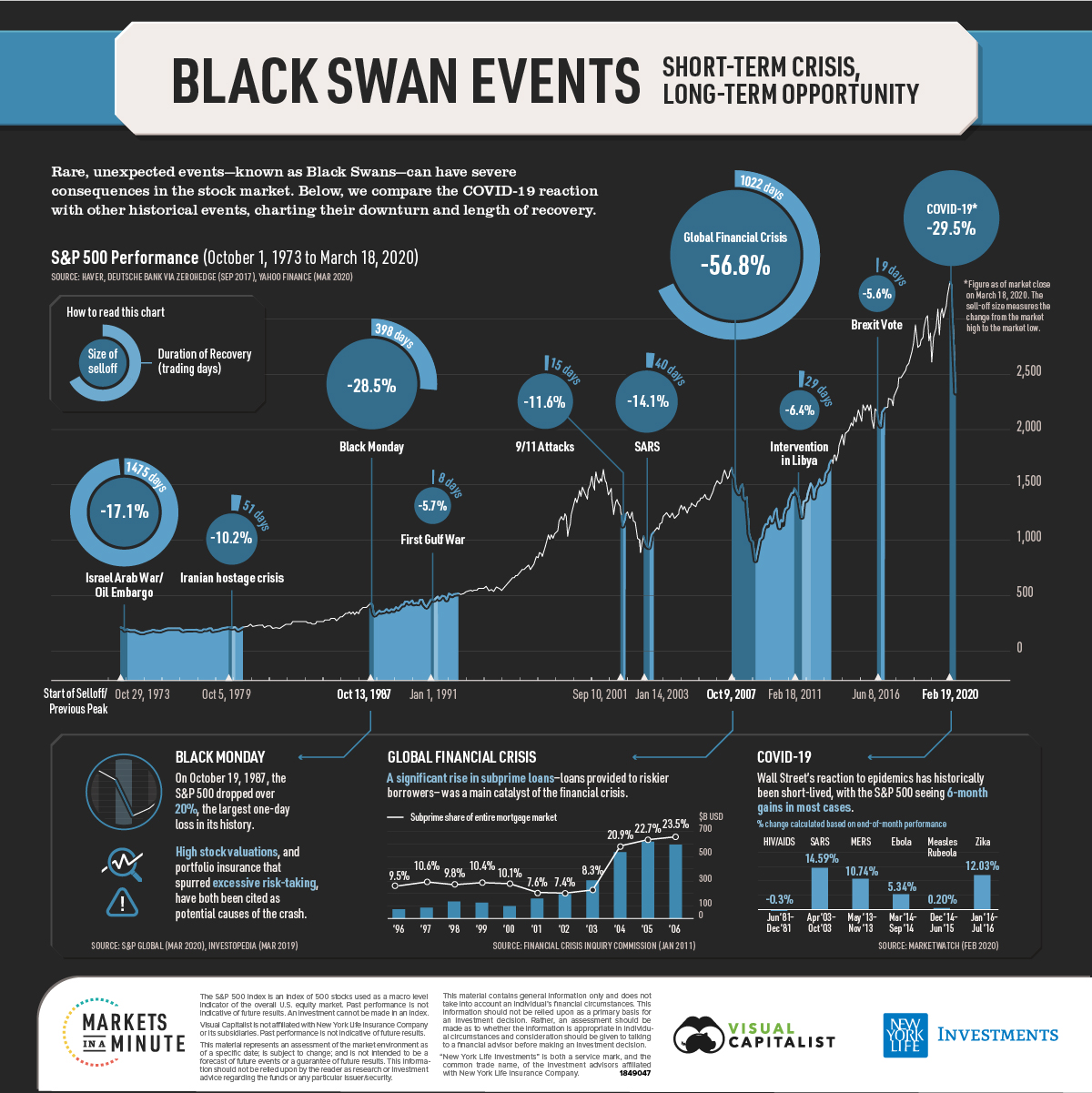](https://advisor.visualcapitalist.com/wp-content/uploads/2020/03/mm_black_swan_events_main-2.jpg)
*Black Swan Event infographic*
## Examples and Applications
### Example 1: The 2008 Financial Crisis
The 2008 Financial Crisis is a classic example of a Black Swan Event. Despite the apparent stability of the financial system in the years leading up to the crisis, a complex web of underlying vulnerabilities led to a systemic collapse with far-reaching consequences.
Several factors contributed to the 2008 Financial Crisis, including:
1. An over-reliance on complex financial instruments (e.g., mortgage-backed securities)
2. Inadequate risk management practices
3. Regulatory failures and poor oversight
While the warning signs of the crisis were present, they were largely overlooked due to various cognitive biases and a failure to account for rare and extreme events.
[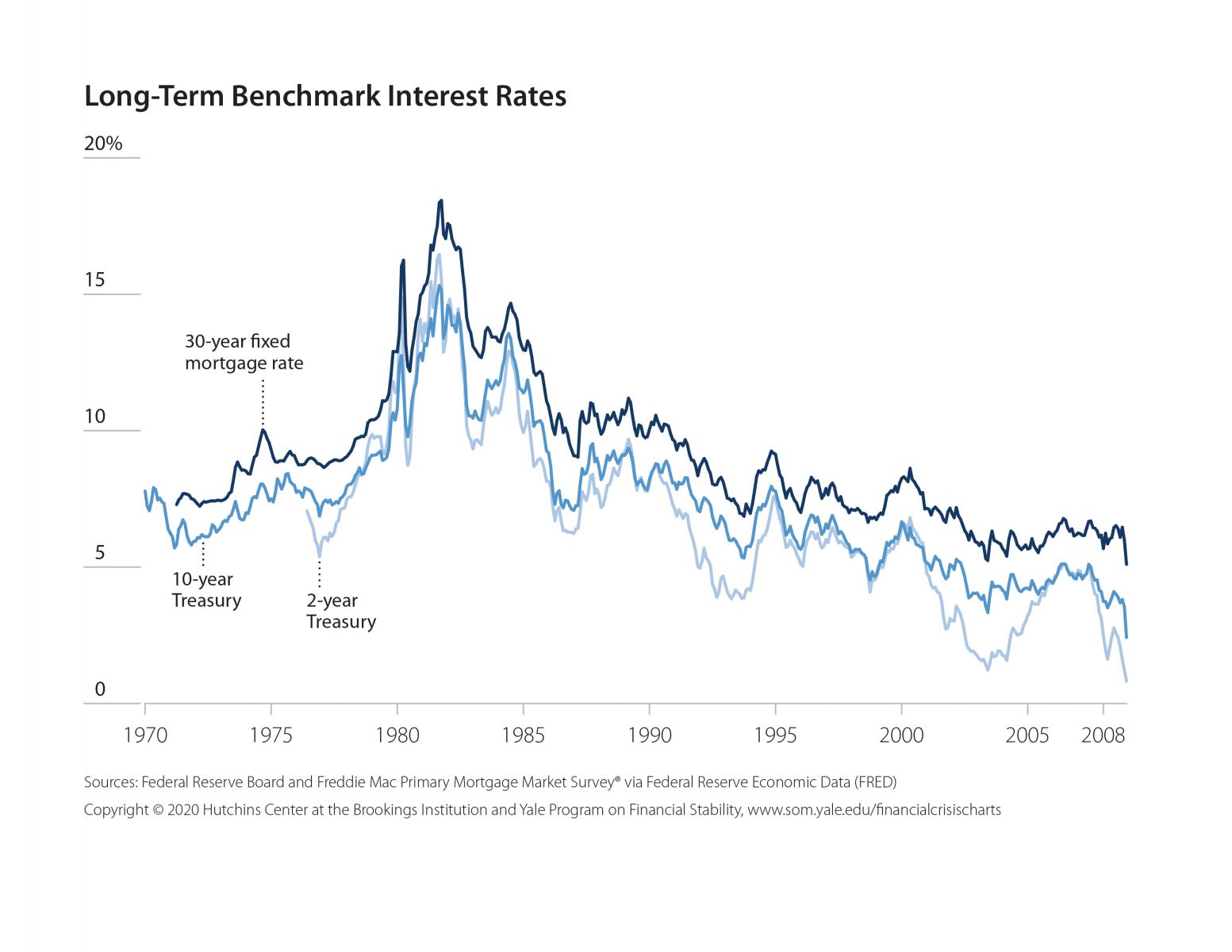](https://som.yale.edu/sites/default/files/2022-01/CB2%2009_Benchmark%20Interest%20Rates%2C%201970%E2%80%932008.jpg)
*2008 Financial Crisis chart*
### Example 2: The Dot-Com Bubble
The Dot-Com Bubble of the late 1990s and early 2000s also provides a valuable illustration of a Black Swan Event. During this time, the rapid growth of internet-based companies (often referred to as 'dot-com' companies) led to a surge in stock prices, which was followed by a sharp decline when many of these companies failed to generate sustainable profits.
Several factors contributed to the Dot-Com Bubble, including:
1. An over-optimism about the potential of internet-based businesses
2. Speculative investment behavior
3. A failure to accurately assess the risks associated with unproven business models
The Dot-Com Bubble resulted in significant losses for investors and reshaped the technology industry.
[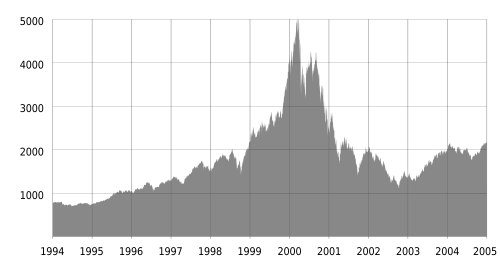](https://upload.wikimedia.org/wikipedia/commons/8/84/Nasdaq_Composite_dot-com_bubble.svg)
*Dot-Com Bubble timeline*
## Key Insights and Further Exploration
By examining Black Swan Events and their underlying mechanisms, we can draw several key insights that can help us better understand and respond to such events:
1. Recognize the limitations of forecasting: Forecasting models, no matter how sophisticated, are inherently limited by their inability to account for extreme and unpredictable events.
2. Embrace uncertainty: Instead of trying to eliminate uncertainty, it is essential to develop a mindset that embraces uncertainty and acknowledges the inherent unpredictability of the world.
3. Focus on resilience and robustness: Rather than attempting to predict and avoid Black Swan Events, it is crucial to build systems and organizations that can withstand and recover from such events.
4. Cultivate a learning mindset: By fostering a culture of continuous learning and improvement, we can better adapt to unexpected situations and respond effectively to Black Swan Events.
To explore the topic of Black Swan Events further, consider:
* Reading Taleb's other works, such as 'The Black Swan' and 'Antifragile'
* Studying the literature on risk management, decision-making, and uncertainty
* Engaging in discussions and debates on the topic with peers and experts in the field
By deepening our understanding of Black Swan Events, we can develop a more nuanced perspective on the world and make better decisions in the face of uncertainty.
Last updated: 2024-05-29
Related Books

Related Knowledges