### Margins of Safety: A Pillar of Prudent Investing
In the realm of investing, the concept of "Margin of Safety" holds immense significance and serves as a crucial tenet of prudent investment strategies. Although the term was popularized by Benjamin Graham—widely regarded as the "father of value investing"—its core principles have been around for centuries.
In essence, the margin of safety represents an investment strategy that seeks to safeguard the investor from losses by purchasing securities at a considerable discount to their intrinsic or estimated true value. By doing so, an investor can achieve two primary objectives: first, to mitigate the risk of making a poor investment decision; and second, to increase the likelihood of generating satisfactory returns.
#### An Exemplification of Margins of Safety
Consider a hypothetical investor interested in purchasing shares of XYZ Corporation, a manufacturing firm trading at $45 per share. To determine the intrinsic value of the company, the investor meticulously analyzes its balance sheet, income statement, and cash flow statement. Based on this analysis, the investor estimates the intrinsic value of the company to be $60 per share.
At this juncture, the investor is faced with a decision: buy the shares at their market price of $45, sell them, or do nothing. If the investor’s estimated intrinsic value is correct, then the market price would need to rise to $60 for the investor to break even. In other words, there is a $15 discrepancy between the estimated intrinsic value and the market price, which can be considered a margin of safety.
In this scenario, the investor can purchase shares of XYZ Corporation at $45 per share, even though the estimated intrinsic value is $60. As long as the investor's estimation is correct, they have secured a "cushion" against losses, as the shares would have to drop significantly in value—below the intrinsic value estimate—to result in a loss for the investor.
#### Further Applications of Margins of Safety
The concept of a margin of safety can be extrapolated beyond the traditional equities market to encompass a myriad of investment opportunities. This section delves into how a margin of safety can be applied in the realms of distressed securities, special situations, and even index fund investing.
##### Distressed Securities
When companies find themselves in financial distress, their securities—such as stocks, bonds, and other debt instruments—often experience significant declines in value. These declines can create opportunities for investors to purchase securities at deep discounts. In such cases, a margin of safety can be identified by comparing the market price of the distressed security to the expected recovery value. This value can be calculated by estimating the company's liquidation value, the potential value of a reorganization, or the future cash flows it can generate.
##### Special Situations
Special situations involve unique corporate events, such as mergers, acquisitions, spin-offs, or restructurings. These situations can create anomalies in asset prices, presenting investors with the chance to generate substantial returns. In special situations, the margin of safety often materializes when investors capitalize on price discrepancies between the market price and the security's intrinsic value during a limited window of opportunity. It is not uncommon for sophisticated investors to deploy capital in these situations to generate short-term returns, taking advantage of the pricing inefficiencies that exist during such periods of transition.
##### Index Fund Investing
Index fund investing has gained significant traction in recent decades due to its simplicity and low costs. Encompassing the entirety of an index, such as the S&P 500, index funds offer investors the opportunity to acquire a broad, diversified portfolio without actively managing it. Proponents of index fund investing argue that it provides an inherent margin of safety, as the broad diversification inherent in index funds reduces the likelihood of underperformance.
#### Key Insights and Further Exploration
The concept of margins of safety has, undoubtedly, withstood the test of time, evolving into a cornerstone of prudent investing. By purchasing securities at a meaningful discount to their intrinsic value, investors can construct robust portfolios that not only minimize the risk of loss but also maximize the potential for favorable returns.
As demonstrated throughout this content, margins of safety can be identified and applied across a variety of investment contexts. The discerning investor would be well-served to internalize this concept, integrating it into their investing arsenal.
As a final note, further exploration of the topic may include:
- Reading the seminal works of Benjamin Graham and other value investing proponents such as Warren Buffett, Seth Klarman, and Joel Greenblatt.
- Engaging in hands-on investment analysis through valuation case studies, ensuring an understanding of the practical applications of margins of safety.
- Participating in investment communities and forums, where like-minded investors can exchange ideas and insights, enriching the collective understanding of this powerful investment concept.
#### References
[1] Graham, Benjamin, and Jason Zweig. *The Intelligent Investor*. HarperBusiness, 2003.
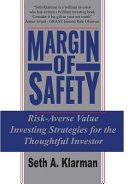
[2] Klarman, Seth. *Margin of Safety: Risk-Averse Value Investing Strategies for the Thoughtful Investor*. Simon & Schuster, 1991.
[3] Greenblatt, Joel. *The Little Book that Beats the Market*. Wiley, 2005.
[4] Buffett, Warren. *Letters to shareholders*. Berkshire Hathaway Inc., 1977-2019.
[5] http://valueinvestingworld.com/graham-net-net-working-capital-stocks/
[6] http://www.investopedia.com/terms/m/marginsafety.asp
[7] http://www.valuewalk.com/2013/10/benjamin-graham-investing-interview-1976/
[8] https://www.morningstar.com/articles/858512/a-short-history-of-indexing
[9] http://www.investopedia.com/terms/d/distressedsecurities.asp
[10] http://www.investopedia.com/terms/s/special_situation.asp
Last updated: 2024-04-07
Related Books
Related Knowledges