# The Byproduct of Argumentativeness: A Fresh Perspective on Human Reasoning
## Introduction
When faced with the question of what makes humans unique, many people would quickly point to our exceptional capacity for reason. The ability to argue, justify our beliefs, and persuade others through logical discourse forms the basis of many intellectual pursuits and social interactions. Yet, the notion of human reason as a powerful tool for arriving at the truth has been challenged by a growing body of research. In *The Enigma of Reason* (2017), authors Hugo Mercier and Dan Sperber propose that reason is not primarily designed to help us arrive at objective truths, but instead, it has evolved as a tool for social communication and persuasion. In this comprehensive overview, we will delve into one of Mercier and Sperber's core arguments: the concept that argumentativeness and its byproducts are not inherently oriented towards the pursuit of truth, but rather, they are often driven by social motivations.
[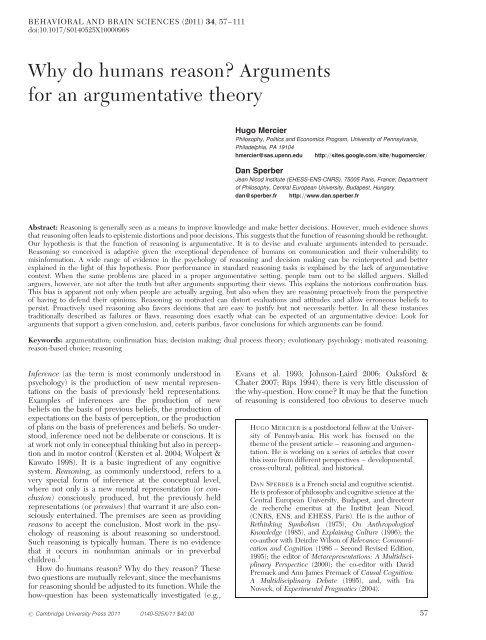](https://img.yumpu.com/48447442/1/500x640/why-do-humans-reason-arguments-for-an-argumentative-theory.jpg)
*Human reasoning and argument*
The authors argue that reason has co-evolved with language and relational dynamics in a way that prioritizes persuasion over objective truth, leading humans to become skilled in employing argumentative strategies for the sake of winning social exchanges and validating their own beliefs. Consequently, the byproduct of argumentativeness may not be an accurate reflection of the facts or evidence at hand, but rather, a sign of the competitive and cooperative pressures that influence human communication and decision-making.
## The Byproduct of Argumentativeness and Its Implications
### Example 1: Political Partisanship and Biased Reasoning
One notable example of the byproduct of argumentativeness can be observed in the realm of political partisanship. Studies have shown that individuals are more likely to accept information that supports their pre-existing beliefs and dismiss competing viewpoints when they identify with a particular political ideology. Within these contexts, individuals often prioritize reinforcing their own ideological stance over evaluating arguments critically and engaging in open dialogue.
[](https://psmag.com/.image/t_share/MTI3NTgxOTU3MzU2ODQyOTc4/arguments.jpg)
*Political partisanship in reasoning*
For instance, consider a heated debate on gun control legislation. When confronted with statistics and evidence that challenge their views on gun ownership, individuals firmly entrenched in their beliefs may cherry-pick data, discredit opposing viewpoints, and contort facts to fit their pre-determined narrative. It is evident that the primary goal is not necessarily to arrive at the truth, but rather, to uphold their social identity and outperform their ideological opponents.
Moreover, political affiliations and social identities can exert profound influences on an individual's reasoning process. Mercier and Sperber argue that this phenomenon is rooted in the basic workings of human reason, where the pressure to defend one's in-group—be it political, religious, or any other affiliation—often eclipses the quest for the objective truth.
### Example 2: Online Arguments and the Illusion of Superiority
Another avenue through which the byproduct of argumentativeness manifests is in online exchanges. The anonymity and distance afforded by the digital realm have further emboldened people to discard the vestiges of politeness and engage in heated arguments that may otherwise be avoided in face-to-face interactions. As a result, social media platforms have become breeding grounds for echo chambers, toxicity, and the relentless pursuit of 'winning' arguments, even at the expense of truth and civility.
Consider an example of an online discussion about climate change. Participants with firmly held beliefs on either side of the debate may enter the conversation with the goal of reinforcing their existing viewpoints rather than genuinely learning from others or striving for a balanced understanding of the issue. Oftentimes, heated exchanges ensue, characterized by logical fallacies, ad hominem attacks, and confirmation bias, further exacerbating the division.
[](https://www.eslprintables.com/previews/760223_1-Social_networks_debate.jpg)
*Online discussion and argument dynamics*
In this context, the argumentative nature of online discourse further demonstrates the byproduct of argumentativeness by revealing social dynamics that prioritize personal victory over constructive dialogue, genuine understanding, and intellectual humility.
## Key Insights and Further Exploration
The concept of the byproduct of argumentativeness presented in *The Enigma of Reason* leads us to critical reflections on the nature of human reason. By recognizing the ways in which our reasoning process is driven by social motivations, we can better understand the pitfalls of our cognitive biases, and craft strategies to mitigate the negative consequences of these tendencies.
Mercier and Sperber's perspectives on human reason have far-reaching implications across various disciplines, urging researchers and practitioners to broaden their understanding of the motivations that underlie our reasoning processes. As critical thinkers and learners, we can explore further by:
- Challenging our assumptions and revisiting pre-existing beliefs, particularly in the context of our social identities and group affiliations.
- Actively and empathetically seeking out diverse perspectives to engage in open dialogue, genuinely consider opposing viewpoints, and practice intellectual humility.
- Engaging in critical self-reflection on our own reasoning processes, asking questions such as: What drives my stance on this issue? Am I truly open to alternative viewpoints or am I more concerned with validating my own beliefs? How can I contribute to a more constructive and civil discourse?
Ultimately, the exploration of the byproduct of argumentativeness incites us to move beyond the traditional understanding of human reason, fostering curiosity and intellectual growth that transcend the limitations of entrenched beliefs. By embracing a more nuanced comprehension of human reason's underlying forces, we will be better positioned to engage with the world in meaningful ways and to foster healthier, more productive discourses that consider the welfare of all.
Last updated: 2024-06-15
Related Books

Related Knowledges