# The Barbell Strategy: Navigating Risk through Asymmetry and Robustness
## Introduction
[](https://upload.wikimedia.org/wikipedia/commons/9/9b/Taleb_mug.JPG)
*Nassim Nicholas Taleb, developer of the Barbell Strategy*
In the field of risk analysis and decision-making, Nassim Nicholas Taleb's work has been revolutionary. Taleb coined the idea of the "Barbell Strategy" as a robust and effective approach to managing uncertainty. This strategy is not only relevant for professionals working in finance but also for college students and individuals who aspire to make informed, strategic decisions in various domains of life.
The Barbell Strategy emphasizes the importance of asymmetry and adaptability while embracing the inevitability of uncertainty. In essence, it is a risk management technique that involves taking opposite positions in an effort to capitalize on favorable outcomes rather than seeking to predict the likelihood of success. This strategy focuses on optimizing for the worst-case scenario, which ultimately allows the individual to take advantage of positive outcomes when they emerge.
In this educational content, we will delve into the core concepts of the Barbell Strategy as articulated by Taleb and explore several diverse examples to demonstrate its real-world applications. We will conclude by summarizing the key insights of the strategy and providing suggestions for further exploration.
[](https://cdn.corporatefinanceinstitute.com/assets/Barbell-strategy-illustration-balancing-scale-1024x614.jpg)
*Illustration of the Barbell Strategy in risk management*
## Core Concepts of the Barbell Strategy
**1. Asymmetry:** The Barbell Strategy rests on the principle of asymmetry in decision-making. Rather than aiming for a balance or equilibrium, the strategy encourages establishing positions on both ends of the risk spectrum, hence the name 'Barbell.' The center or intermediate levels of the risk spectrum are considered volatile and unreliable.
**2. Robustness and Adaptability:** The Barbell Strategy promotes the cultivation of robustness and adaptability in the face of uncertainty. By hedging against risks through asymmetric bets, the individual is better prepared to absorb losses while capitalizing on gains.
**3. Inevitability of Uncertainty:** Uncertainty is an inherent aspect of life and cannot be wholly predicted or controlled. The Barbell Strategy does not attempt to predict or eliminate uncertainty; instead, it seeks to create a robust framework for managing risk and uncertainty.
## Real-World Applications of the Barbell Strategy
### Financial Investments
Perhaps the most well-known application of the Barbell Strategy lies in financial investments. Portfolios can be structured through the Barbell Strategy with a focus on two extreme ends of the risk spectrum and little reliance on the intermediate levels.
On the one end, the individual might choose to invest in low-risk assets such as Treasury Inflation-Protected Securities (TIPS) or government bonds. At the other end of the spectrum, investments in high-potential-return assets such as stocks, real estate, or start-ups might be pursued. The intermediate level is deliberately avoided as it typically represents assets with moderate risk-reward profiles that are prone to market fluctuations and unpredictability.
By following this approach, the individual is well-positioned to manage the inevitable market uncertainty while optimizing for both conservative growth and high-reward returns.
[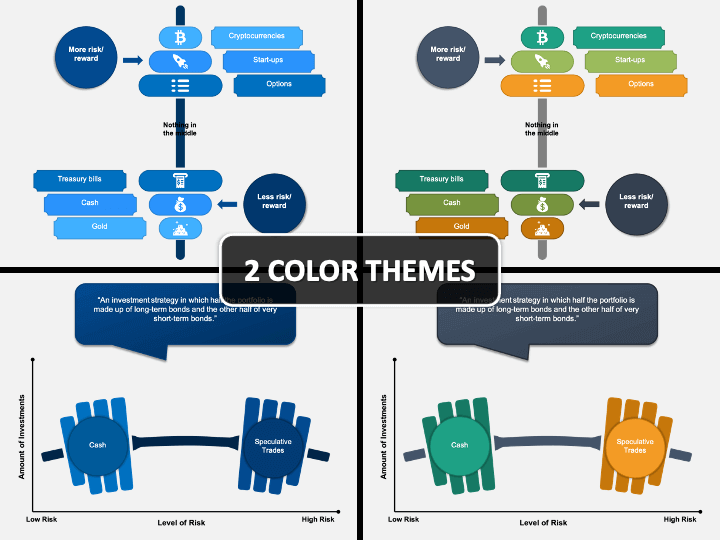](https://cdn.sketchbubble.com/pub/media/catalog/product/optimized1/f/4/f4f685bac8647729ae5539a0c5ededf71f8a367349c078b78d498bc41bc66e91/barbell-strategy-base-slide.png)
*Example of a diversified investment portfolio using the Barbell Strategy*
### Career and Education
Apart from finance, the Barbell Strategy fits equally well in managing personal career and education risks. In the pursuit of a successful career, a student might balance an education in a more stable, traditional field alongside emerging or niche areas with significant growth potential.
For example, a student interested in pursuing a technology-focused career could pair a Computer Science degree with courses or side projects that explore emerging fields like artificial intelligence, blockchain, or data science. The former presents a stable career path, while the latter signifies the high-potential-return end of the risk spectrum.
This adaptation allows the student to make the most of the opportunities in the fast-evolving job market and improve adaptability despite the uncertainty.
[](https://media.self.com/photos/6398b36c72eb56f726777d06/4:3/w_2560%2Cc_limit/weekly-workout-schedule.jpeg)
*Example of balancing career opportunities using the Barbell Strategy*
### Personal Relationships and Networking
Beyond financial and career implications, the Barbell Strategy can be extended to personal relationship-building and networking. By investing in both wide and narrow networking strategies, individuals can increase their robustness and minimize vulnerability.
The broad or "weak tie" connections can serve as a safety net, opening up new opportunities and helping navigate life's uncertainties. Meanwhile, deep and specific "strong tie" relationships can lead to more focused, strategic results but are more volatile.
In our increasingly interconnected world, the Barbell Strategy for personal relationships facilitates a more resilient and adaptive path for success.
## Key Insights and Further Exploration
When applying the Barbell Strategy, it is important to keep the following key insights in mind:
* Maintain a balanced perspective on uncertainty and risks.
* Avoid relying on intermediate levels of the risk spectrum that can be volatile.
* Focus on developing robustness, hedging against risks, and being adaptable.
* View uncertainty as a given, and manage risks within this context.
For further exploration, consider the following additional resources and topics:
* Reviewing Taleb's book "Antifragile" for a deeper understanding of the Barbell Strategy and its applications.
* Digging into other risk management techniques and concepts, such as the Black Swan theory and Extremistan vs. Mediocristan scenarios.
* Researching the role of uncertainty in decision-making processes and how asymmetry can contribute to optimal outcomes.
In conclusion, the Barbell Strategy offers a novel, resilient, and adaptive approach to navigating today's uncertain and fast-changing world. By understanding its core concepts, embracing real-world applications, and internalizing key insights, students and professionals will be better positioned to succeed in managing risks and seizing opportunities.
Last updated: 2024-04-06
Related Books

Related Knowledges